

By Esther Melander, AG®
Any research project will begin with a research objective and background information. The background information will contain key details of the research focus, such as names, vital dates, and a location or two. A genealogist will take that information and create a research plan, identifying key record collections to learn more. A genealogical trail develops as the researcher builds on newly discovered information, leading to additional record collections to search.
The research process is multifaceted. It relies partly on the researcher having the knowledge and understanding of record types and local history. But it also relies on evidence analysis, an important skill for genealogists. The researcher will analyze the presented information or a specific source, identify key details, interpret the results, and then determine the next steps. A researcher may not know all of the possible record collections or types in a location, but they know how to find and learn more about what is available.
Case Study
This case study about John Henry Eaton illustrates the process, beginning with the research objective. Very often, a research objective contains client-provided details with few, or maybe no source records. The information may not be entirely accurate, but it is the starting point for the research. For example:
The objective of this research project is to identify the parents of John Henry Eaton. John Henry was born on 16 March 1882 in Lauderdale County, Alabama. He married Hautie Lou Smith on 30 July 1899 in Loretto, Lawrence County, Tennessee. John Henry died on 16 April 1956 in Florence, Lauderdale, Alabama.
From here, a researcher will develop a research plan based on known and unknown information. They will answer the questions:
- What do I know?
- How do I know it?
- What do I want to know?
It can be difficult to know how to start and what to do next. Many researchers will develop a research plan by consulting research reference guides [or sources], such as the FamilySearch Research Wiki and guides like the Local History and Genealogy Research Guides at the Library of Congress. These resources will identify record collections, explain record availability, and provide the historical background of any events that could have impacted record creation. The FamilySearch Research Wiki includes articles that explain different record types, such as census records, death certificates, and immigration records. Each record type provides different types of information, so it is important to know which records will help answer the research objective.
In short, the researcher has to spend time doing background research before jumping into the actual research for the objective. The background research will guide the researcher in developing a research plan by:
- Knowing record availability in the locality
- Identifying available record types that will answer the question
What do you know?
The objective of this research is to identify the parents of John Henry Eaton (1882–1956). To establish a credible baseline, we begin with the following known facts provided by the client:
- Name: John Henry Eaton
- Birth Date: 16 March 1882
- Birth Place: Lauderdale County, Alabama
- Spouse: Hautie Lou Smith
- Marriage Date: 30 July 1899
- Marriage Place: Loretto, Lawrence County, Tennessee
- Death Date: 16 April 1956
- Death Place: Florence, Lauderdale County, Alabama
The “Recent-to-Past” Principle
One helpful methodology that can save time is to use the “Recent-to-Past” principle. A common tactical error for novice researchers is attempting to begin at the subject’s birth (1882). In Alabama, centralized birth records did not exist in the late 19th century. Instead, we start with the most recent event—the 1956 death. Modern records are legally standardized and far more accessible. By starting the research in the 20th century, we extract the necessary clues—such as names, dates, and locations—to bridge the gap into the less-documented past.
The FamilySearch Research Wiki for Lauderdale County, Alabama Genealogy lists death-related record collections. This includes a collection of Alabama death certificates. The article explains Alabama mandated the recording of deaths at the state level starting in 1908, reaching general compliance by 1925. Because the subject’s death occurred in 1956, we can be certain that a state-level death certificate was a legal requirement. This justifies a targeted search of the Alabama Deaths, 1908-1974 record collection at FamilySearch.
The FamilySearch Research Wiki article on United States Death Records has a section about Death Certificates. Death certificates can provide an essential list of important details about the deceased, including the names of parents. The article lists additional sources that could be useful, including the Social Security Death Index, Obituaries, Cemeteries, etc. By spending time between the locality research and record type research, a list of record collections can be added to the research plan. Additional record collections can be added to the plan, moving backward in time for each life event.
Starting Research
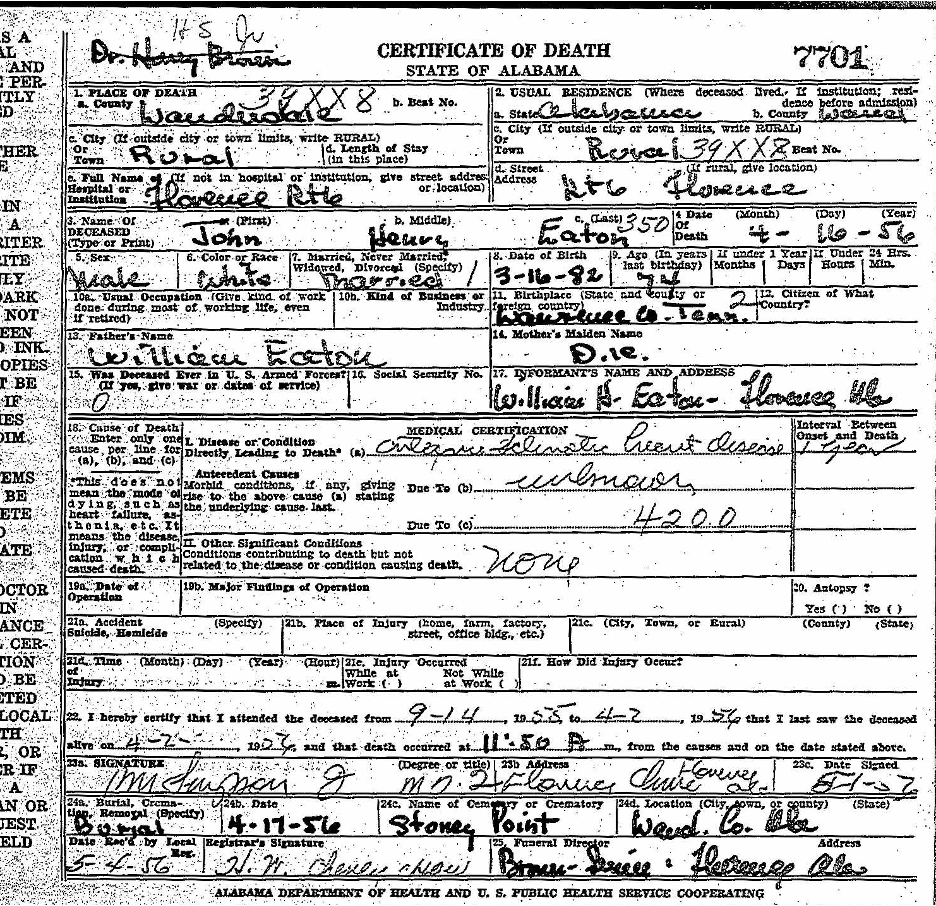
The background research for John Henry Eaton led to the development of a research plan with a list of record collections. The first record collection identified to search was Alabama Deaths, 1908-1974, to find a death certificate for John Henry Eaton. The search yielded the Certificate of Death for John Henry Eaton (File No. 7701).1 The document provided several key data points:
- Birth Date: 3-16-82
- Death Date: 4-16-56
- Subject’s Birthplace: “Lawrence Co Tenn”
- Father’s Name: William Eaton
- Informant: William H. Eaton (Address: Florence, Ala.)
Evidence Analysis
As each record collection is searched, records are analyzed to identify information that answers the research question. The researcher will also look for clues that could lead to additional records. This means the research plan can be modified to add or remove collections as needed. In this research scenario, this analysis might look like this:
Analyzing this record, I see an immediate red flag regarding informant reliability. The informant is William H. Eaton. What is his relationship to John Henry Eaton? Most likely, William H. Eaton is a relative because he has the last name of Eaton. He lives in Florence—the same city as the deceased—suggesting proximity. Yet, when asked for John Henry’s mother’s name, he responds with ‘D.K.’ (Don’t Know). How is it that William H. Eaton knows John Henry’s father, but not his mother? The death certificate states John Henry was buried at Stoney Point. Perhaps there is a cemetery record. I should look at Find A Grave for a memorial for John Henry Eaton.
The research then continues by searching the next record collection, analyzing the evidence, adding to the research log, updating the research plan, if needed, and so on until record collections have been exhausted.
The research plan for John Henry’s parents proceeded forward by next looking at Social Security records. Following the Social Security Act of 1935/1936, the SS-5 application became an important source of direct testimony. Unlike a death certificate, the SS-5 is a primary record where the individual likely provided their own parental information.
The Social Security Claims Index (SSN 416-28-5446) for John Henry Eaton revealed the following:2
- Application Date: April 1941
- Birth Date: 16 Mar 1882
- Birth Place: Green Hill L, Alabama
- Father: William J. Eaton
- Mother: Rhoda A. Pelt
At the time of this application in 1941, John Henry was 59 years old. John Henry most likely reported his parentage, even if he was assisted in filling out the application. While the information was recorded decades after his birth, John Henry is a vastly more reliable source for his mother’s maiden name than the informant on his death certificate fifteen years later.
With two record sources, John Henry’s parents have been identified as William J. Eaton and Rhoda A. Pelt. While these two records alone aren’t sufficient to draw a firm conclusion, they serve as a starting point for uncovering additional evidence. For example, the research plan could be expanded to include a search of marriage or census records for William J. Eaton and Rhoda A Pelt.
Report
After completing the research, it’s essential to deliver a clear, written summary to the client outlining the conclusions drawn from the evidence. A written conclusion should demonstrate the chain of evidence, where the report briefly explains what was found and why it was important. For example, the report might include a paragraph like this:
The conclusion that William Jasper Eaton and Rhoda Emily Pelt were the parents of John Henry Eaton is established through a linked chain of evidence beginning with his 1956 death. While the Alabama death certificate provided the first evidentiary link by naming ‘William Eaton’ as the father, the informant was unable to identify the mother. To resolve this, the research transitioned to records where John Henry served as his own informant, specifically his 1941 Social Security application. This record provided the vital ‘missing link’ by explicitly naming both William J. Eaton and Rhoda A. Pelt.
When writing up results, consider these elements:
- Identify the “Trigger”: State what specific piece of information in Record A (e.g., the father’s name) made you look for Record B.
- Address the Gaps: If a record is missing, explain that the “jump” to the next record was a necessary strategy to bypass that specific historical hurdle.
- Highlight the Informant: Note who provided the information in each link of the chain, as this explains why certain records are considered more authoritative for establishing proof than others.
- Resolve Conflicts: Spend time identifying information that may disagree between records. Explain why it is or is not important.
A successful research project begins with background research in the location, record collections, and record types. A research plan is developed by listing the record collections to search that will help answer the research objective. As records are analyzed, key information is extracted, evaluated, and logged. From there, the research plan may be adjusted by adding or removing record collections to search. Once all the research collections have been exhausted, a written report explains the chain of evidence, linking the records together to form a strong conclusion.
The rest of the story…
John Henry Eaton’s parents were William Jasper Eaton and Rhoda Emily Pelt/VanPelt. The only documentation that supported the conclusion came from records created later in John Henry’s life. John Henry was born in 1882, after the 1880 U.S. Census. His mother died when he was four years old in 1886. If the 1890 U.S. Census had survived, John Henry would have been listed with his father and stepmother, Mariah Hannah Smith. John Henry first appeared in the 1900 U.S. Census with his wife, Hautie Lou. This means there was almost no opportunity for John Henry to have appeared on a record with his parents from his birth until his marriage in 1899. Despite the difficulty, it was necessary to work the research plan and check each record collection, starting with his death and working backwards in time, to do thorough, exhaustive research.3
Sources
- “Alabama Deaths, 1908-1974,” entry for John Henry Eaton, no. 7701, 1956, Lauderdale County, Alabama; digital images, FamilySearch (https://familysearch.org : accessed 30 June 2023).
- “U.S., Social Security Applications and Claims Index, 1936-2007,” entry for John Henry Eaton, SSN 416285446, Birth 16 March 1882, Lauderdale County, Alabama; digital images, Ancestry (https://ancestry.com : accessed 17 April 2026).
- Esther Melander, The Four Generations of the Eaton Family in Alabama: from Gracie Cleo Eaton, John Henry Eaton, William Jasper Eaton to William Jasper Eaton (Esther Melander: Idaho, 2024).
Discover more from ICAPGen℠
Subscribe to get the latest posts sent to your email.

