
Category Archives: Application process

The Application Process: Level 2 (Written Exam)

We are detailing the ICAPGen℠ accreditation process in a series of posts, and today we take a look at Level 2’s written exam.  Previous posts have covered Level 1: The Four-Generation Project and Level 1:  Genealogical Research Experience.  For the complete guide to the application process, Levels 1-4, you can view and download a PDF of the Guide to Applying for an Accredited Genealogist® Credential from the ICAPGen website.  If you still have questions regarding the accreditation process we would love to hear from you, so feel free to contact us.

OVERVIEW

When you have achieved Level 1 recognition, you may take up to three years to apply for the next level of testing.

The written exam is given in two parts: Level 2 and Level 3. One Saturday a quarter has been scheduled for the written exams. A person may take one level exam (Example: either Level 2 or Level 3 or retake of Level 2 or retake of Level 3) during this scheduled test day. After Level 2 is passed those wishing to test sooner than the next quarterly scheduled test day may request “Custom Onsite Testing,” Additional charges apply. See Fee Schedule for details.

The Level 2 exam lasts over four hours, including breaks. You will be allowed to use a facility computer for research and a separate computer for testing. All files that you create will be deleted from the testing computer at the end of that test section. The exams are open book (this includes the Internet).

You will attain Level 2 status by achieving a score of 90% or better on sections 1-4 of the written exam. The Level 2 exam includes the following sections.

GENERAL KNOWLEDGE

You will be tested on your general knowledge of facts pertaining to the history, geography, research methodologies, and records of your region. You may be questioned about historical events that affect research in your region or be asked about types of records available in your region – their content, availability, and coverage.

Preparation Tip: The FamilySearch Family History Research Wiki also provides a list of handwriting resources and other online links for understanding early handwriting for various languages to help you prepare for this portion of the test.

HANDWRITING

You will be tested on your ability to read a genealogical document (or documents) relative to the geographic area and time period of your area of specialty. Be prepared to transcribe and answer questions about a handwritten document from an early time period from the chosen testing region.

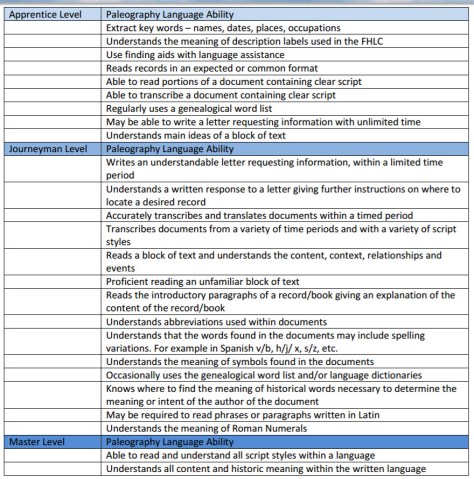
If you are accrediting in a region with a language other than your native language, you will be expected to accurately translate documents of genealogical significance written in that language. Use the Language Ability Table to help you rate your own abilities in dealing with foreign-language issues and to see if you are ready to take this portion of the exam.

Preparation Tip: The FamilySearch Family History Research Wiki also provides a list of handwriting resources and other online links for understanding early handwriting for various languages to help you prepare for this portion of the test.

DOCUMENT RECOGNITION

Potential clients might provide documents with insufficient citations, or no citations at all. You will be tested on your ability to identify important types of documents and reference sources for your area of specialty. Be familiar with a variety of documents covering a range of years for your chosen region.

Preparation Tip: For suggestions of genealogical record types, see the “Important Record Type List” for your chosen region shown in tables available from “Resources, Record Types, and Strategies” on our website.

INTERNET SOURCES AND ELECTRONIC DATABASES

You will be tested on your knowledge of the content of Internet sources and electronic databases created by non-profit groups and commercial organizations relating to your geographical area.

Preparation Tip: The FamilySearch Family History Research Wiki offers many suggestions of Internet sources and collections for worldwide locations

QUICK REFERENCE GUIDE

The test is open book, meaning you can consult Internet resources, reference books and personal note files for the written portion of the exam. These files will be used for quick reference as there will not be enough time during the exam to consult the original references.  We encourage you to develop your own quick reference guide to use during the exam.


The Application Process: Level 1 (The Four-Generation Project)

Are you curious about what it takes to receive the Accredited Genealogist® credential? The accreditation process involves three levels of testing of the applicant’s skills and knowledge.  A previous post discussed the first part of the Level 1 requirements–“Genealogical Research Experience.”  In this blog post we describe the second part of Level 1 requirements–“The Four-Generation Project.”

The Guide to Applying for an Accredited Genealogist Credential PDF, available on the ICAPGen website, describes the entire accreditation process and includes the following instructions for the Four-Generation Project:

The purpose of the ICAPGen Four-Generation (Application) Project is to test an applicant’s ability to do the following:

  • Conduct research based on a well-defined objective.
  • Report all research findings, analysis of evidence, and conclusions based on that evidence, as if to a client.
  • Properly apply the following relevant context to the research objective.
    • Historical
    • Geographical
    • Legal
    • Methodological
    • Social

The project may encompass research in both derivative and original records. It is expected that the project will consist primarily of research in original records. These records could be viewed or obtained from record repositories, Internet resources, or from local sources. They should represent the best sources to answer the four-generation problem.

The project should present four connecting generations who lived within the same geographic region. Your presentation of four connecting generations in your project should represent your knowledge of a variety of records that are useful at different times in your chosen region. The regional focus allows for practice in records that might be included in the written exams.

Many of our ancestors migrated from one geographical region to another so we might have to choose a family other than our own for the four generation project. This might be the ancestry of another family member, a client, or a family that is known to have four generations that lived in the same geographic region. We might also select from our own ancestry a related descendant line that meets the criteria. Note that privacy issues are not violated because the records are for events of people born in 1900 or earlier and identities of living persons are not included in the report. The following items must be submitted electronically as part of the project:

  • A pedigree chart.
  • Family group records.
  • Research report.
  • Documents
  • Research calendar or log

Pedigree Chart

A pedigree chart showing only four generations in the study is required as part of the four-generation project. (This means only the four families in the study.) Your pedigree will be evaluated using the criteria listed below.

  • The individual in the most recent generation was born in 1900 or before.
  • The pedigree chart displays only the four generations (families) in the study.
  • All dates and places designated on the chart (i.e., born, baptism, marriage date, marriage place, death, death place) for each couple is complete with either exact or approximated information from sources.
  • Items on the pedigree chart match items on the family group records.

Family Group Records

At least four family group records are required (one for each generation represented on the pedigree chart). If anyone on the pedigree was married more than once, you must also submit family group records for those additional marriages. Those marriages do not need to be fully discussed in the report unless that family is key to proving the generational links. Instead, refer the reader to the Family Group Record. Your family groups will be evaluated using the criteria listed below.

  • Each family group record contains complete event dates and places on each individual listed on the record (dates and places may be approximated).
  • Information on all children in the family are included (living people may be left off).
  • All events are sourced using consistent citations.
  • Information on family group records matches information on the pedigree chart and in the report.

Submit your pedigree and family group records in PDF format. ICAPGen does not accept GEDCOM files or databases. Only a pedigree and family group records created from personal genealogical software are accepted as part of the of the four-generation project. No forms from online family trees like FamilySearch Family Tree or Ancestry.com Trees are allowed. Online family trees do not allow the same features that ICAPGen measures as part of the application. (e.g. the ability to print a one-line pedigree)

Research Report

The ability to write an excellent research report is one of the hallmarks of an excellent genealogist. There are many acceptable ways to format a research report. The most important components of an excellent research report are the treatment of the evidence and the effectiveness of the researcher in communicating what was accomplished during the research session.

Client reports may vary in length and style, depending upon the client’s needs and instructions. An average size four-generation project research report is 25 pages. Reports must not be larger than 40 pages. The four-generation research report must include the following elements:

  • Research Objectives: Should be clear and concise.
  • Introduction (aka Background Information): Should briefly discuss information known about the starting individual.
  • Presentation of Data: Should contain all research findings.
  • Evidence Analysis: Should be incorporated into the presentation of data.
  • Conclusion: Should be solidly based on evidence presented in the report.
  • Future Research Recommendations: Should contain items not fully researched or items to research toward a new goal.

The purpose of the four-generation research report is to present research findings and conclusions to a client. ICAPGen requires that applicants adopt an ascending format for the four-generation research report (begin with the most recent ancestor and work back to the remote ancestor).
[Descending format accepted under special circumstances with prior approval of the testing committee.]

The four-generational report is key in determining an applicant’s abilities to analyze evidence and form conclusions based on that evidence. When a report simply gives a narrative of what was found our raters cannot effectively judge the applicant’s abilities to do this. All four-generation research reports should include the following:

Proper methodology applied by the applicant. This should include:

  • Consistent use of original sources when available.
  • Use of the correct records for the area and time period, used in an appropriate manner, and in a logical order.
  • Reasons that give (1) the purpose of searching records or (2) what valuable information the researcher expected to find in those records.
  • Research strategies that reflect laws, customs (such as naming patterns or inheritance customs), historical background, jurisdictions, and record access typical for the accreditation area.
  • A project stated objective, research calendar(s), and evidence analysis which indicate that the research was accomplished in an acceptable manner.
  • A report that clearly explains the significance of key findings provided in the documents.
  • Good suggestions for future research to solve the stated research objective, or to support a new research objective, were included.
  • Transcription or abstraction (translation if in a foreign language) of key records that identify or link generations need to be within the body of the report. (Large documents should be abstracted.)

Analysis of the evidence. An AG® professional’s ability to understand the evidence found in their research is what sets them apart from the amateur. Your project will be evaluated on the evidence presented in your project report and how well you explained that evidence based on the criteria listed below.

  • The writer demonstrated an understanding of how to accurately compare and weigh evidence. When terms such as “primary information,” “direct evidence,” “derivative source,” etc. were used, they were used appropriately.
  • The evidence presented was properly analyzed and correctly interpreted.
  • Solid conclusions were made that were fully supported by the evidence presented in the report.
  • No unjustified conclusions or hasty generalizations were made. The evaluation was not “tailored” to fit a pre-conceived notion.
  • All conflicting evidence presented in the report was fully addressed and, where possible, conflicts were resolved appropriately.
  • The report makes appropriate connections, shows coherent thinking, recognizes and provides analysis of assumptions and inferences, and provides compelling conclusions or syntheses.
  • All generational links were proven with supporting evidence.
  • The research findings were presented clearly and in a logical order.
  • Clear, professional writing style and presentation.

See “Incorporating Evidence Analysis, in a Research Report “to learn about including evidence analysis into a report.

For additional help with writing a report refer to Becoming an Excellent Genealogist, Essays on Professional Research Skills discussed on the home page of our website.

Documents

Documents referred to in the four-generation project need to be submitted with your project. Below outline requirements for documents:

  • Digital copies of key documents referenced in the research report need to be submitted with the four-generation project.
  • Documents submitted should provide generational linking evidence. It is expected that no more than 40 images be submitted.
  • The documents should be properly referenced in the report, research calendars, and family group sheets.
  • The images should be readable without adjustments. (For instance raters should not have to rotate images to read them.)
  • Images should be labeled with a document number and a citation on the front of them so that someone can easily tell which image belongs to which record referenced in the report, research calendar, and family group records.

Research Calendar

It is required that research calendars or logs be submitted as part of the four generation project. Your research calendars will be evaluated based on the following criteria and should include:

  • Names of persons, events, or records searched.
  • The repository or website where the item was found.
  • A description of the source used, i.e. type of record, time period covered, etc.
  • A call number, film number, or URL of each record searched.
  • Document numbers for all documents located.
  • Positive and negative search results.
  • Complete citations for all sources.