

Category Archives: Hiring a Professional

Finding the Right Genealogist: How to Use ICAPGen’s Find an AG® Professional Directory

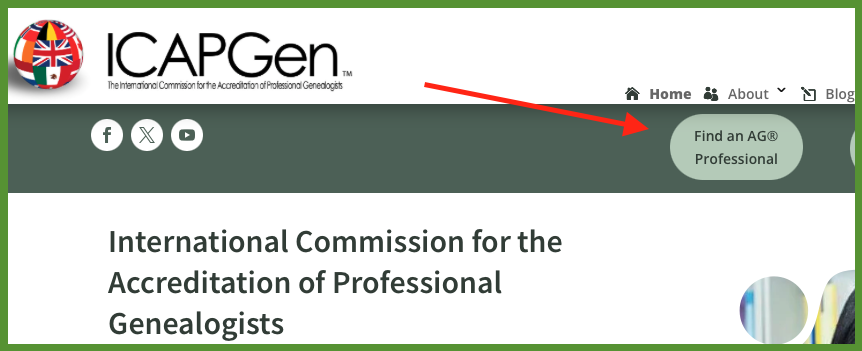
Snapshot of the ICAPGen website header highlighting the Find an AG Professional directory button.

By Michelle Tucker Chubenko, AG®, AGL™

Whether you are facing a brick wall, need help with international records, or want expert guidance for a specific research challenge, finding the right genealogist can make a significant difference. The International Commission for the Accreditation of Professional Genealogists (ICAPGen℠) offers a searchable directory of Accredited Genealogist® (AG®) professionals designed to help researchers connect with specialists who have demonstrated expertise in specific geographic regions and research areas.

The Find an AG® Professional directory is more than a simple list of names—it is a powerful tool that can help you identify AG® professionals whose specialties closely match your research needs.

Additionally, if you are seeking a speaker for Society events, you may want to seek an Accredited Genealogist Lecturer™ (AGL™). These individuals are AG® professionals who have demonstrated excellence in both genealogical knowledge and presentation skills.

Start here: Find an AG® Professional Directory

Step 1: Begin with Keywords

The main directory search includes a keyword field in which you can use search terms, such as:

  • Surnames
  • Accreditation areas
  • Geographic locations
  • Specialized topics
  • Research topics such as DNA, military, religion, or ethnicity

Be sure to think strategically about the problem you’re trying to solve. For example, specific terms such as New Jersey, Poland, German, DNA, Jewish, Military, or Immigration. Avoid searching too broadly at first. A search for “Europe” may be too general, while “Mexico” or “Sweden” may produce more useful results.

Step 2: Use Advanced Search Features

The Advanced Search page allows you to narrow results beyond simple keywords. Advanced search can save time, especially if you have a specific goal. Filters currently include:

  • Name
  • Credential region (e.g., Canada, US African American, and others)
  • Whether a professional is accepting clients
  • Speaking availability: search for professionals available for virtual or in-person speaking
  • Residence location: search by specialty and location together for regional expertise

Search Tips for Better Results

1) Try multiple versions of a place
Genealogical research often involves changing boundaries and jurisdictions. Conduct keyword searches not only with the modern location, but with historical territory names. For example, instead of searching only Ukraine, use the historical Empires terms of Imperial Russia, Russian Empire, Galicia, Austria, or Poland.

2) Search for methodologies and specialties
Not all expertise is geographic. You may uncover specialists who work with specific record types or methodologies.

3) Review profiles carefully
Each AG® professional has the ability to present an online biographical profile which may contain accreditation areas, expertise details, additional credentials, speaking availability, client availability, links to their website, published articles and much more.

Read beyond the accreditation title. Someone accredited in one region may also have additional research strengths relevant to your project.

Step 3: Contact more than one professional

ICAPGen recommends identifying several AG® professionals before making a hiring decision. Compare specialties, project approaches, availability, and fee structures.

A brief message should include:

  • Your research question
  • Ancestor names
  • Time period
  • Geographic location
  • What you hope to accomplish

Specific information helps a genealogist determine whether they are the right fit. Read more about hiring an AG® professional: Ten Effective Steps to Hiring an AG® Professional.

One Final Tip

Think of the directory as a research tool, not just a listing of names. Experiment with search terms, combine filters, and explore profiles. A few extra minutes spent refining your search may connect you with a specialist who has exactly the expertise your research problem requires.

The right genealogist does not simply search records—they bring methodology, regional expertise, and experience to complex problems.

And sometimes, that is exactly what breaks down a brick wall.


See other posts in this series:

Ten Effective Steps to Hiring an Accredited Genealogist (AG®) Professional” by Trish Melander, AG®

Not All Genealogists are the Same: Understanding Genealogical Credentials Before You Hire,” by Melanie Marsh, AG®

What will a Professional Genealogist do for Me? Having Realistic Expectations” by Melanie Marsh, AG®
Why Becoming an Accredited Genealogist® Professional Is Worth It

iStock

By Trish T. Melander, AG®

Considering accreditation? It may be one of the best investments you can make in your genealogical career.

Genealogy is more than a hobby or even a profession—it’s a calling. And for many researchers who feel that calling deeply, one eventually asks themselves: Should I become accredited?

If you’re exploring that question, you’re already on a path of growth. Earning the Accredited Genealogist® (AG®) credential through ICAPGen℠ is more than a professional milestone — it’s a transformative experience that elevates your skills, your confidence, and your credibility.

Let’s walk through some of the reasons why many genealogists choose to pursue accreditation—and why it might be right for you, too.

1. Join a Legacy of Professional Excellence and Ethics

For more than fifty years, accreditation has served as an independent, trustworthy way to demonstrate true genealogical competence. When you earn the AG credential, you join this heritage of quality research, ethical practice, and professional rigor. The Code of Ethics signed by each AG professional ensures the public that honest communication, transparency in research limitations, respect for client confidentiality, properly citing sources, and accurately representing results are hallmarks of your work. 

Your commitment sets you apart and builds trust before a client ever meets you.

2. Increase your Visibility by Developing Specialized Expertise in a Specific Region

One of the unique strengths of ICAPGen accreditation is its regional focus. Candidates choose a specific geographic area and must demonstrate deep, practical expertise in the records, history, and cultural context of that region. The “Find an Accredited Genealogist Professional” directory on the ICAPGen website illustrates the areas around the world where accredited professionals are already working. Your deep skills in one of these regions can set you above the rest as a specialist in that area. Additionally, your specific expertise allows you to add professional post nominals (“AG®”) after your name, be listed on the ICAPGen website, where many clients find accredited professionals, and become more appealing to clients seeking expert genealogy help.

By the time you complete the accreditation process, you’ll feel confident handling even some of the most challenging research problems.

3. Independent Verification of Your Genealogical Skillset

Anyone can claim to be a genealogist. A credential proves it.

Accreditation is an objective, third-party evaluation of your research skills, analytical thinking, evidence correlation, writing clarity, and ability to solve complex genealogical problems. Maybe you are already refining some of these skills without the benefit of a defined path and a measuring stick to help you see areas for improvement in your work. Often, we can be so excited about the research that we don’t spend much time documenting it in writing to help a client review the results. Striving for accreditation allows you to put these skills to work in a concise body of work that is reviewed and awarded the credential when it’s ready — with stepping stones along the way if areas of your work need to improve.

That independent verification can be incredibly empowering — both for you and for anyone who hires you. You will build confidence to take on more complex client work, present and publish with authority, communicate your findings clearly, and build stronger client relationships.

4. Strengthen Your Research Skills Through Training and Preparation

Preparing for accreditation makes you a better researcher—regardless of where you are in your career. ICAPGen offers webinars, study groups, practice materials, and guidance from experienced AG professionals.

By the time you complete the accreditation journey, you will have sharpened every aspect of your research process—from methodology and analysis to report writing and time management.

Renewing your credential every five years to keep it current allows you to continue to refine your skills and demonstrate that refinement to other AG professionals in a manner that supports your growth. Your client’s ongoing mystery weaving through Georgia and Alabama may allow you multiple opportunities to use new methods of analysis, and come to sound genealogical conclusions over time.

5. New Opportunities to Serve, Lead and Expand

Once accredited, you will also have opportunities to serve within the ICAPGen organization. Some of these include serving a term as a commissioner, working with one of the testing committees, as a mentor or study-group leader, or supporting accreditation development. 

AG professionals are committed to building the genealogical community, and take opportunities to lead genealogical societies, our credentialing organization, libraries, and special research groups. It’s a chance to give back to the community, collaborate with other professionals, and help shape the future of genealogical standards.

Will the benefits make your effort pay off?

If you’re passionate about genealogy and committed to professionalism, accreditation can be one of the most meaningful steps you take in your career. As we’ve discussed here, it can expand your opportunities, broaden and deepen your knowledge, and connect you with a community of researchers who have demonstrated their skills as a professional.

The journey requires dedication, but the benefits last a lifetime.

And who knows? A few years from now, you may be the one inspiring new candidates to begin their own accreditation journey!