Category Archives: Skillbuilding

Foundations: Research Questions

Concept of problem analysis, creativity analytical thinking process Or find out the cause that happened during the process, hand holding  light bulb with the question mark inside.
iStock image

By Melanie Marsh, AG®

Your curiosity has been gnawing at you for a while, and you’ve decided to start looking for more information about your great-grandparents. Or maybe you’ve decided to pursue professional accreditation. Today. Not tomorrow. You sit down at your computer and sign in to FamilySearch, Ancestry, or your chosen family tree software or platform… and you stop, staring, trying to decide if the blank spaces are taunting or beckoning you.

Perhaps your online tree has a few generations, or maybe many. Either way, you realize there is a lot more to discover. Each empty branch of that tree is beckoning you, all at once, and you may feel the overwhelm starting. Reframe it.

Ask the right question

Our efforts will be most meaningful if we ask questions. The first one is often, “But where do I start?” Alone, that question is hard to answer. Instead, let it lead to answerable, focused questions about one person at a time. These questions become our research goals. If you are a goal-setter, you know that setting clear, realistic goals means you have a better chance of achieving them. It’s the same in genealogy. The clearer the goal, the more likely you’ll reach it!

Saying, “I want to know about my great-grandparents” is good, but it’s so broad you’ll almost certainly find yourself either paralyzed with overwhelm or wandering with every wind of a hint that comes along. Focused questions are specific goals or objectives, clear enough to prevent the overwhelm and the wandering that inevitably come with overly broad or undefined goals.1

A solid, answerable research question is clear, focused, and narrow. Consider the difference between “I want to know about my great-grandparents,” and “When and where did my great-grandparents, William and Henrietta Blair, get married?”

Both are good. Both center on one couple. The difference: one could be all-encompassing, the other is focused on one event and relationship.

A better question

Start with the second question–refine it. Add details from any clues you have for when and where they were married. Do you know when their first child was born? Do you know where they lived when that child was born? If you know, for example, they had a daughter named Dorothy who was born in Cass County, Illinois in 1918, use the date and place of her birth as clues in your question to start your search for marriage records to answer your research question.

Here’s an example of what I mean:

William Otis Blair and Henrietta Muncy lived in Cass County, Illinois when their daughter Dorothy was born on 15 February 1918. When and where did William and Henrietta marry?

Your Turn

Try writing a few research questions yourself. Look at the information you have, whether it’s already in your online tree or in the documents you’ve collected. What do you want to know? Make it specific. Add a relationship, a date, and a place. Write clearly. Refine it as needed.

Answering one question gives you part of the story, and raises many more questions to answer. Questions about their lives, the context of their life experiences, what they might have read in the newspapers, how their crops grew or their business did that year, and so on.

Crafting a good research question is the first step in building a solid foundation for successful research.


1 Research questions, research goals, research objectives, research problems, and similar are all terms for this same concept: start with what you know, then decide what you want to know next.


Read the original post at MarshGenealogy.

Watch for the next post in the Foundations series.

Mastering Mid-Atlantic Research: Resources and Methodologies for ICAPGen Accreditation

A Legacy Family Tree Webinar on 29 April 2026

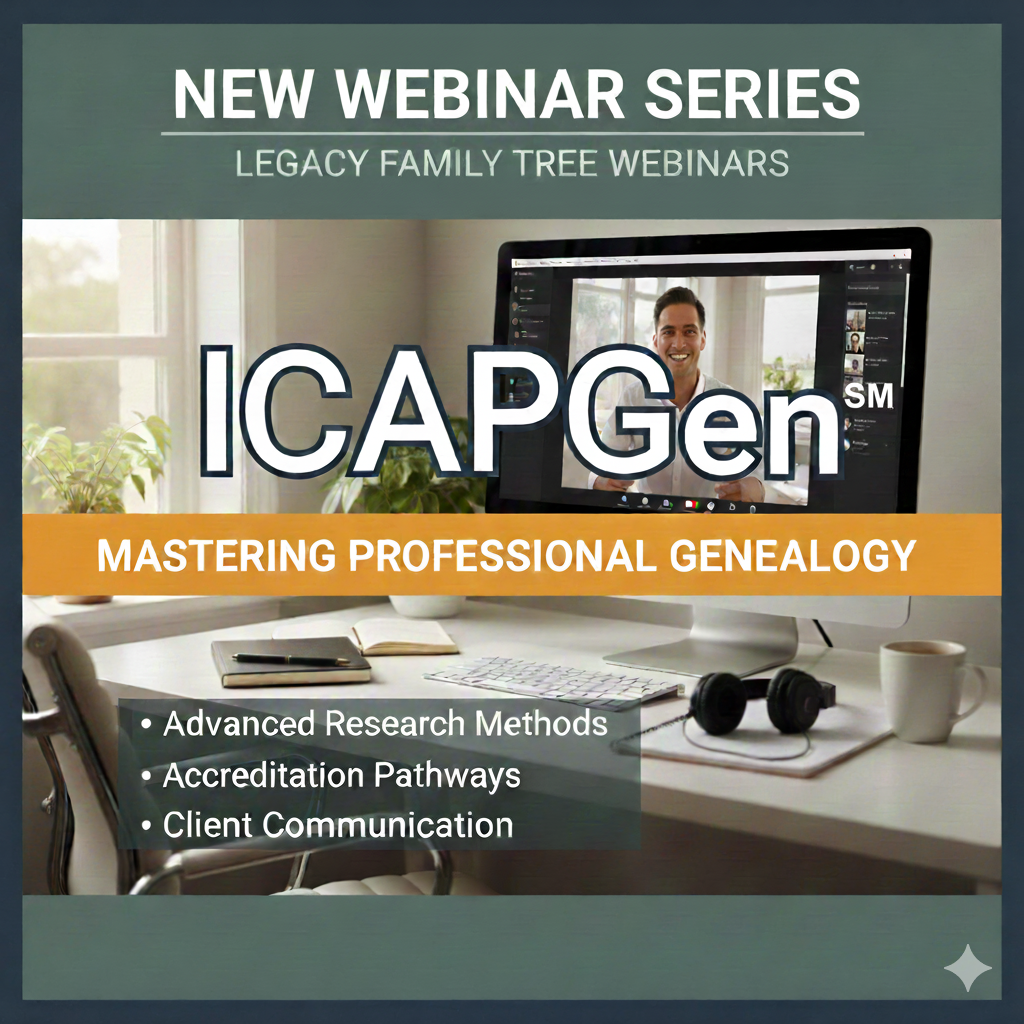
Image generated by Gemini 3, 2025, Google AI

📅 Wednesday, July 29 — 2:00 pm EST

📝 Mastering Mid-Atlantic Research: Resources and Methodologies for ICAPGen Accreditation


Alice Childs, AG®, will provide an overview of essential resources and methodologies for researchers preparing for ICAPGen accreditation in the U.S. Mid-Atlantic region, including insights and challenges unique to the region. Learn how a Personal Reference Guide can be your personalized key to successfully research in Delaware, Maryland, New Jersey, New York, and Pennsylvania.

🔗 Details and registration for Mastering Mid-Atlantic Research: Resources and Methodologies for ICAPGen Accreditation.

Alice is ICAPGen’s second lecturer in a four-part ICAPGen series this year at Legacy Family Tree Webinars; Torhild Shirley, AG®, was our first lecturer.  In the coming months, we’ll hear from Kaye Ford, AG®, and Bonnie Wade Mucia, AG®, AGLTM.

This webinar is free to watch live and for one week afterward. After that viewing period ends, a Legacy Family Tree Webinars subscription is required to access the recording.


About the Webinar Series:
The webinar series will focus on key aspects of accreditation—from exam preparation to regional methodologies. Whether you are just starting to explore accreditation or are deep into building your Four Generation Project, these sessions will provide practical, actionable guidance rooted in ICAPGen standards and requirements. Each episode is dedicated to helping researchers understand the accreditation process and build the regional expertise required to earn the Accredited Genealogist® credential.

We are grateful to Legacy Family Tree Webinars for providing a platform to make high-quality, accreditation-focused education more accessible to genealogists everywhere. We look forward to supporting candidates across all regions as they build their skills and prepare to become Accredited Genealogist professionals.

Stay connected for additional updates, resources, and future webinar dates. We hope you will join us for this exciting series!