
By Esther Melander, AG®

There is nothing more fun than jumping into the research and making discoveries. However, professional genealogists are more methodical. The first step of a research project is to define a research objective. A research objective states the goals of the project along with some basic background information. The next step after defining an objective is to develop a research plan. A research plan is a bridge between defining a research objective and research. A well-structured plan offers several key benefits:
- A list of record collections to be searched that are most likely to contain information that will achieve the objective.
- Locations where record collections can be searched (online, archives, libraries) and any access limitations.
- A focused list of record collections or sources, to hopefully avoid being sidetracked or derailed by other interesting discoveries.
Effective and efficient plans require preparation. They include researching locations, historical events, and the types of records that would have been created during the life of the individual being researched. There are many sources available to jump-start a research plan. Here are a few recommended starting points:
- FamilySearch Research Wiki
- Library of Congress Research Guides
- Ancestry, MyHeritage, and FamilySearch catalogs
- State, National, or special Archives
- Local Libraries
- Genealogy Society collections
Experienced researchers will already know about many specific collections, but there is always more to learn as new record collections become available. While U.S. research practices are similar across the country, each state and county has unique collections. It is important to take time to discover and identify the collections for the research location that might provide the evidence needed to reach the research objective.
Research plans can have multiple research phases, in which research is broken into separate sessions with smaller goals under a larger research objective. Breaking the research into smaller sessions with smaller goals can help build a case in more manageable chunks. These chunks could be focused around specific life events or around specific record types, such as census records, land records, or cemetery research. Additional research could be focused on key friends, associates, or neighbors, or on social or historical context.
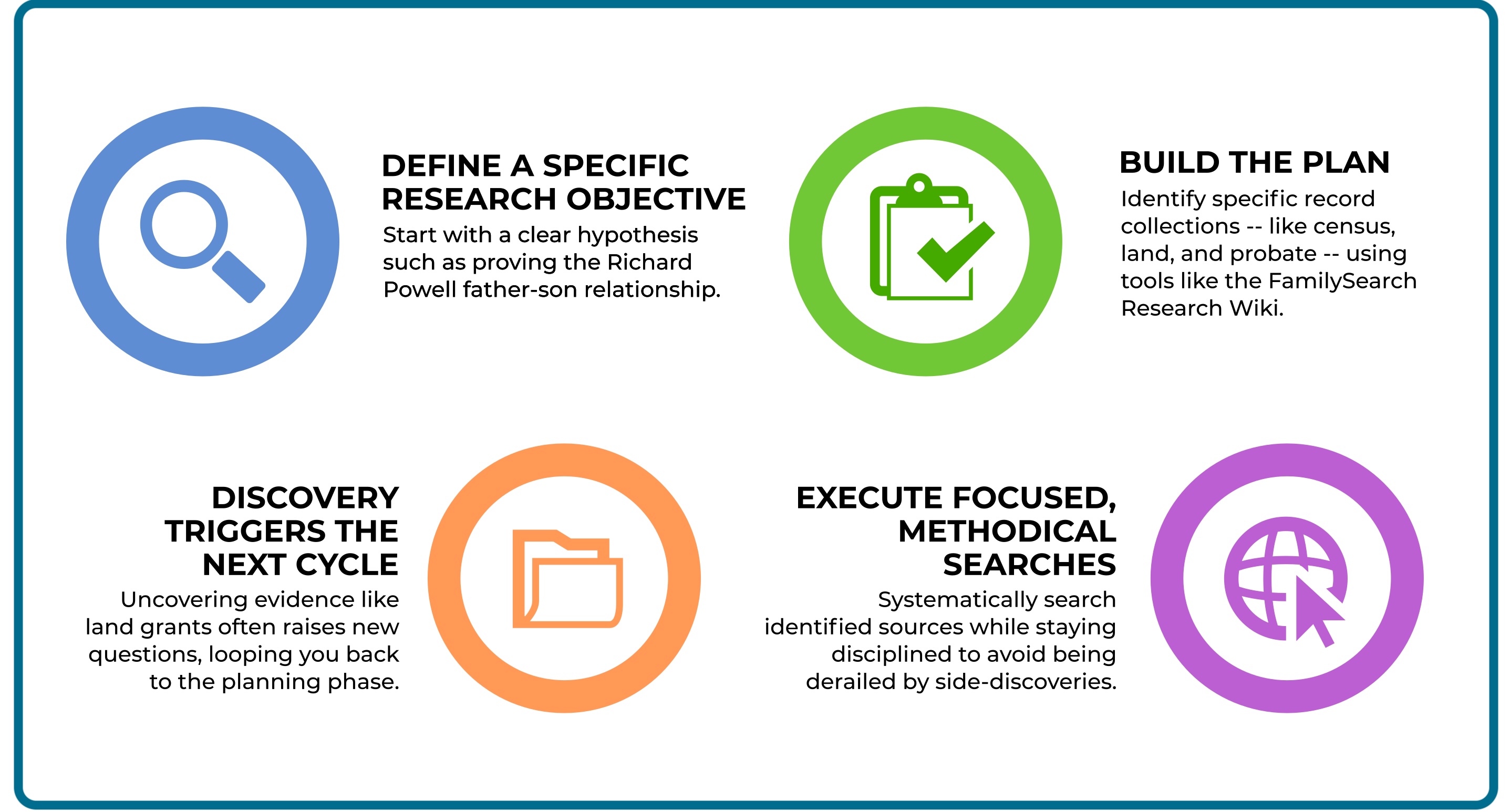
Types of Research Plans
Research performed for a client will be outlined and directed by a research plan, which serves as a statement of work. This type of plan will often be narrow in scope and specific. For example, the plan will list the record collections to be searched and the desired information to be obtained. Any work outside of that scope could be suggested for future research.
Other research plans, perhaps for personal use, might be less formal. For example, the plan may start with an initial list of record collections to search. As the research proceeds, additional collections may be added as discoveries are made or questions arise. This dynamic nature provides some flexibility in the research but helps the overall project stay focused and efficient. Each genealogist has their own preferences, creating plans that suit their own methods and personal style.
Case Study
One of my current research projects examines the connection between a hypothetical father and son, both named Richard Powell in South Carolina. Adding to the challenge are the time frame, location, and availability of records. Here is the research objective with a bit of background:
“The objective of this research is to test the hypothesis that Richard Powell (1800) of Lawrence County, Tennessee, was the son of Richard Powell (1745) and Sarah of Union County, South Carolina, using both documentary research and DNA evidence. Richard Powell (1800) was born about 1800 in South Carolina. He had seven siblings, including Benjamin Powell and Rebecca Powell. Richard (1800) first married Susan and had six children, and then in 1861 married Mary Malone and had two more children. Richard Powell (1800) died after 1870 in Lawrence County, Tennessee. Richard Powell’s (1745) origins are unknown, but he was enumerated in Union County, South Carolina in the 1790 U.S. Census. Richard Powell died about 1801 in Union County, South Carolina.”
Planning the Project
This complex research project requires researching multiple individuals and multiple locations. To keep me organized, I created a research plan broken up into phases based on the individuals. The primary goal was to find documentation showing a father-son relationship. If the documentary evidence does not exist, or is weak, then indirect evidence will be necessary. This is why the research plan included additional individuals highlighted by DNA matches. Here are the research phases:
- Richard Powell (1745), hypothetical father, Union County, South Carolina
- Richard Powell (1800), Union County, South Carolina, Forsyth County, Georgia, and Lawrence County, Tennessee
- Sarah Powell, hypothetical mother to Richard Powell (1800), Union County, South Carolina
- Benjamin Powell, hypothetical sibling to Richard Powell (1800), Union County, South Carolina and Lawrence County, Tennessee
- Rebecca Powell, hypothetical sibling to Richard Powell (1800), Union County, South Carolina and Moniteau County, Missouri
Organizing the project into research phases by individual and location has kept the project focused and on track. The research phases provide a path for thorough and exhaustive research. Otherwise, it would be easy to feel overwhelmed and easily sidetracked.
The research plan began with Richard Powell (1745) because of a known will that identified a wife and children. But what other records could be discovered that show a father-son relationship? A study of the FamilySearch Research Wiki and Catalog identified resources for searching. The real research plan included specific record locations and links, omitted here for brevity.
Richard Powell (1745), Union County, South Carolina
- Search Wills and Probates to find a source citation for the will. Transcribe the will and identify the relationships, if stated, for the named individuals.
- Search the 1800 U.S. Census for Richard Powell in Union County, South Carolina. What are the age ranges and gender of any children counted in the census? Is there a male child in the youngest child category? Is the child a match for a son born about 1800?
- Search land records for Richard Powell (1745 & 1800) using FamilySearch Full Text search.1 What land did the elder Richard Powell originally have in the county? Was any of this land passed to the younger Richard? For example, a deed may include a land description that states, “Land originally owned by Richard Powell, deceased” or some other statement to indicate land that was inherited.
- Search South Carolina state archives for additional documents related to land acquisition. Richard Powell arrived in Union County before the American Revolution. Did he receive a royal land grant from the Governor? Was this land mentioned in the will and passed to his sons?
- Members of Benjamin Powell’s family were buried at the Second Creek Primitive Baptist Church in Lawrence County, Tennessee. Was the family also members of the Baptist church in Union County, South Carolina? The FamilySearch Research Wiki lists the Fairforest Baptist church as one of the earliest Baptists churches established in Union County. Search the church records for Fairforest Baptist church for membership lists and other vital data for Powell family members. Could the church records have included documentation to show a parent-child relationship between the two Richards?
Observations
By methodically following this plan for just the first phase of research, amazing discoveries were made. For example, I was able to find the royal land grant and plat for the land Richard Powell (1745) originally acquired. Additional records traced the disposition of the land to his children after his death.
Surprising discoveries can occur, even while focusing on specific questions or record collections. While searching the South Carolina State Archives, I stumbled across a record for Richard Powell’s (1745) service in the American Revolution.2 A search for military records was not initially included in the research plan, but this discovery opened up new possibilities. Did Richard Powell’s (1745) wife apply for a pension? Did any of his children receive a land grant as the child of a veteran? These questions were added to the research plan for future research.
The Rest of the Story
The research for the two Richard Powells is ongoing. DNA analysis and limited documentary evidence does show the hypothetical father-son relationship is most likely real. The research has been expanded to include more indirect evidence that includes additional family members, friends, and associates to help bolster the conclusion.
Whether breaking a large objective into manageable phases or adapting to surprising discoveries like the Revolutionary War service record, a research plan provides the necessary flexibility and focus to build a solid case. While the excitement of the hunt is undeniable, it is the methodical preparation and strategic execution outlined in a research plan that transforms a collection of data points into a verified family history. For both professional researchers and hobbyists, the plan is not just a formality; it is the foundation of accurate and efficient genealogical work.
1 The FamilySearch Full Text search is an amazing, game-changing resource that continues to improve. For example, search results can be narrowed by date range, location, record type, and even a specific collection. In this scenario, a search for Richard Powell in Union County, South Carolina returned results for both Richard Powell (1745) and Richard Powell (1800). It was important to pay attention to the dates to correctly identify which Richard was being mentioned in the record.
2 “Accounts Audited of Claims Growing Out of the Revolution (S108092),” entry for Richard Powell, 20 June 1786, South Carolina, document 6086, Series S108092, Reel 0120, Frame 00222, ignore 000; digital images, South Carolina Department of Archives and History (http://www.archivesindex.sc.gov : accessed 12 June 2026).
Other posts in the Foundations series:

